MLOps Consulting Guide for Reliable ML Pipelines
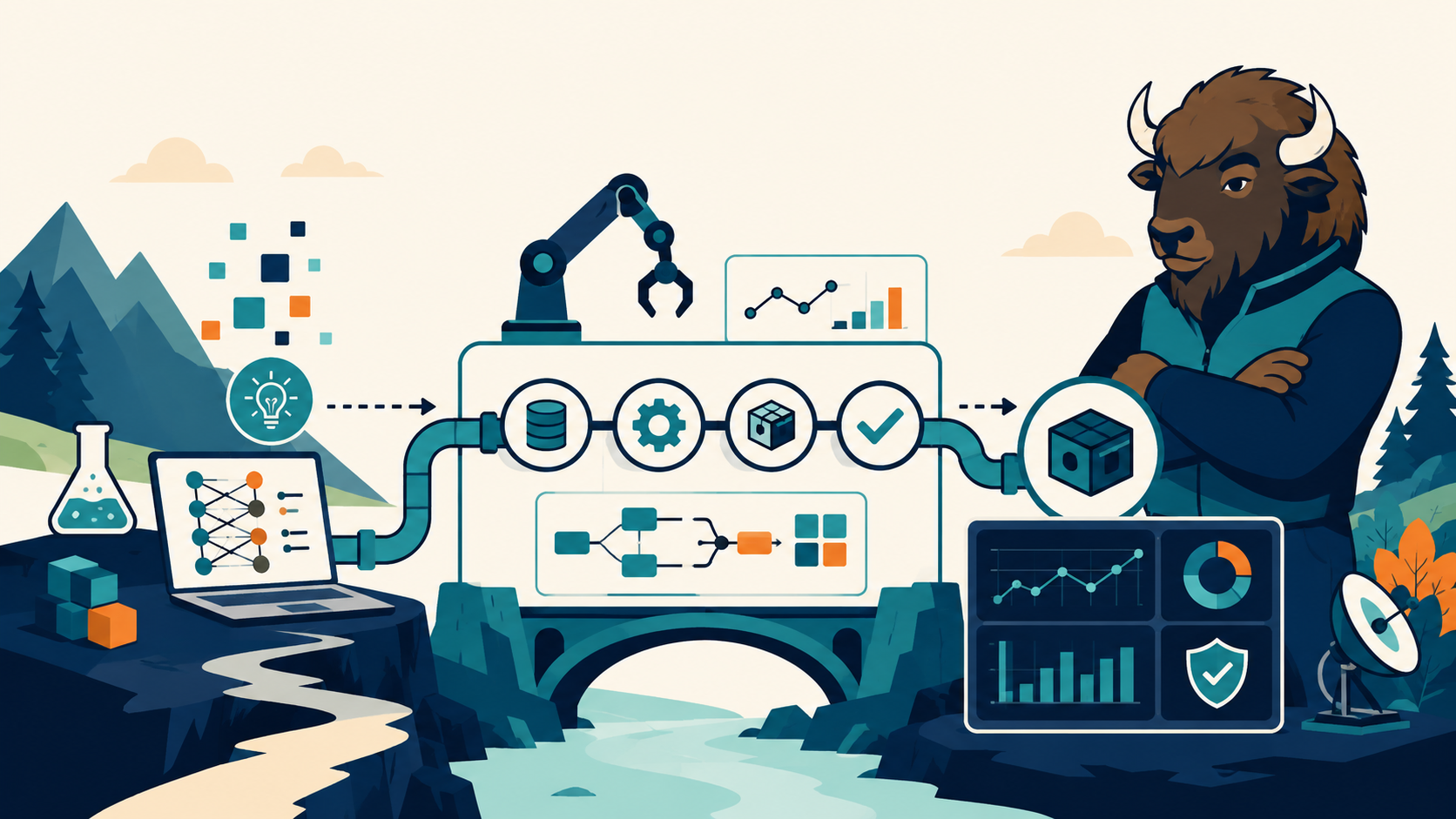
The MLOps market is projected to grow from USD 4.39 billion in 2026 to USD 89.91 billion by 2034, with a 45.8% CAGR over that period (Fortune Business Insights). That kind of growth changes the question from "Should we operationalize machine learning?" to "How do we keep ML reliable after it reaches production?"
That's where MLOps consulting comes in. It's the work of turning prototypes into systems that can survive real traffic, changing data, audits, and handoffs between data science, engineering, and operations teams. In practice, consultants close the gap between model experimentation and production discipline, especially when organizations are wrestling with fragmented tooling, manual deployment steps, and weak monitoring.
A strong consulting engagement doesn't start with a tool list. It starts with the full lifecycle, data ingestion, feature creation, training, deployment, observability, rollback, and governance. The best consultants help teams build repeatable workflows, not one-off demos that collapse the first time traffic changes or a model drifts.
Table of Contents
- Introduction to MLOps consulting
- Why MLOps consulting matters now
- Core components of MLOps consulting
- Designing reliable ML pipelines and reproducible workflows
- Implementing production-grade monitoring and model operations
- Driving ROI with MLOps consulting
Introduction to MLOps consulting
A company can have a model that looks excellent in a notebook and still fail the moment it's exposed to production traffic. The problem is usually not the algorithm, it's the operational path around it. MLOps consulting exists to design that path so the model can be trained, deployed, monitored, and updated without turning every release into a fire drill.
What consultants actually fix
The work usually starts with a simple but uncomfortable assessment. Where does data come from, who owns the pipeline, how are model versions tracked, and what happens when a prediction goes wrong? In many organizations, those answers are scattered across teams and tools, which is why consultants focus on building a single operating model that connects engineering, data science, security, and platform operations.
That can mean setting up deployment workflows, defining reproducibility standards, or creating governance around when a model can move from test to live traffic. It can also mean helping teams decide what should be automated, what should be reviewed manually, and what needs an explicit rollback path.
Practical rule: if a team can't explain how a model moves from training data to a live endpoint, it doesn't have an MLOps process yet, it has a collection of scripts.
Why the consulting angle matters
Consulting adds value when the bottleneck isn't model quality alone. The friction usually lives in handoffs, environment drift, version mismatch, weak traceability, and unclear ownership after launch. The goal is not just to ship faster, it's to make every launch safer and easier to operate.
That's also why MLOps consulting is different from generic data science help. A consultant who understands production AI will ask about logging, incident response, evaluation gates, service-level metrics, and how a model behaves when the underlying data changes. Those questions sound operational because they are.
Why MLOps consulting matters now
The market signal is hard to ignore. The MLOps market is forecast to grow quickly, which shows that organizations are no longer treating machine learning operations as an experiment. They are budgeting for the systems, controls, and routines that keep models reliable after deployment.
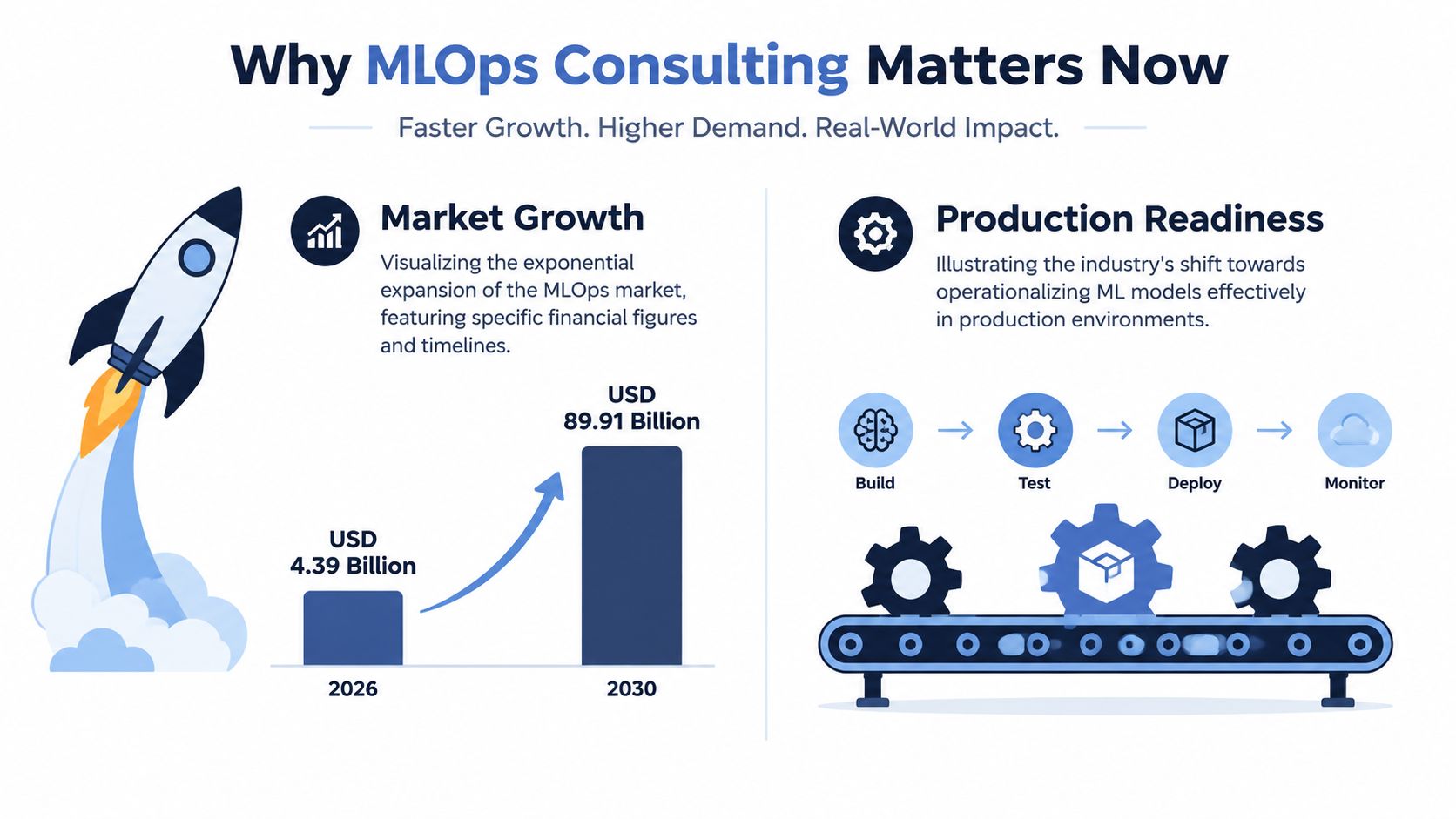
The market moved from niche to operational budget
The shift became visible in the early 2020s, when model operations started to stand on their own as a business function rather than an informal engineering habit (Mordor Intelligence). That matters because buyers began asking a broader question. They want to know whether the whole lifecycle can be run with the same discipline as production software.
The same report points to the pain points that pushed that change: manual model deployment, fragmented MLOps tools, low model lifecycle automation, and insufficient model monitoring. Those gaps are not cosmetic. They show up as delayed releases, hard-to-trace failures, and models that behave well in testing but drift in real use.
Why production readiness wins budget
When ML moves into production, the work changes shape. Teams need deployment steps they can repeat, governance that still works under pressure, and monitoring that catches silent failure before customers do.
That is why consulting often focuses on the full operating lifecycle, not just tool choice. A good consultant helps map handoffs, tighten evaluation gates, and define what happens when model behavior changes after launch. High-availability architecture, evaluation pipelines, and cloud modernization all matter because they close operational gaps that directly affect ROI. If a model cannot be supported, observed, and corrected in production, its business value stays theoretical.
Core components of MLOps consulting
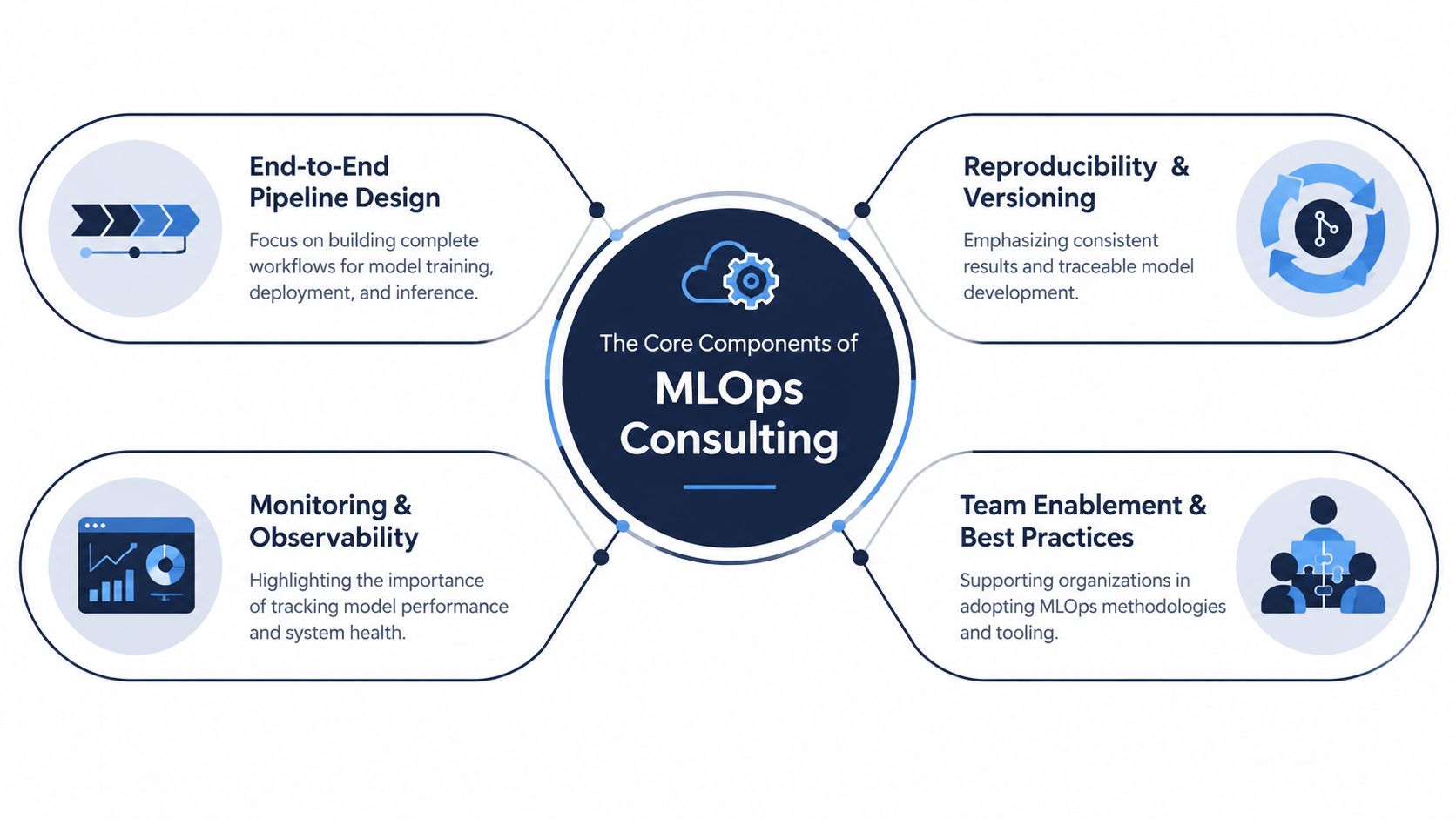
Most engagements break down into four connected capabilities. Treating them as separate workstreams usually creates gaps, because the model can't be reliable if the pipeline is brittle, and monitoring can't help if no one can trace what changed.
End-to-end pipeline design
Consultants first map the route from data to prediction. That includes ingestion, feature engineering, training, validation, deployment, and inference. The important part is not just automation, it's making every step visible enough that teams can tell where a failure began.
Reproducibility and versioning
A model without traceability is hard to trust and even harder to fix. Consultants usually introduce artifact versioning, experiment tracking, and CI/CD integration so that code, data, and model outputs stay tied together. That makes it possible to answer basic questions later, like which dataset trained a deployed model, or which configuration produced a bad release.
Monitoring and observability
Production ML failures can be subtle. The service can keep returning valid-looking outputs even when predictions are wrong, which is why monitoring has to capture inputs, outputs, actuals, and drift signals. The observability stack should make it possible to separate model regressions from infrastructure faults quickly.
Team enablement and operating habits
The final layer is usually the least glamorous and the most important. Teams need shared language for rollout, retraining, ownership, and incident handling. Consultants often leave behind operating patterns, decision rules, and review practices, because tooling alone doesn't fix unclear responsibility.
The real value comes when the organization can run the system without heroic effort from one specialist.
A strong engagement doesn't optimize one box in the stack. It connects all four so the platform, the people, and the release process reinforce one another instead of pulling apart.
Designing reliable ML pipelines and reproducible workflows
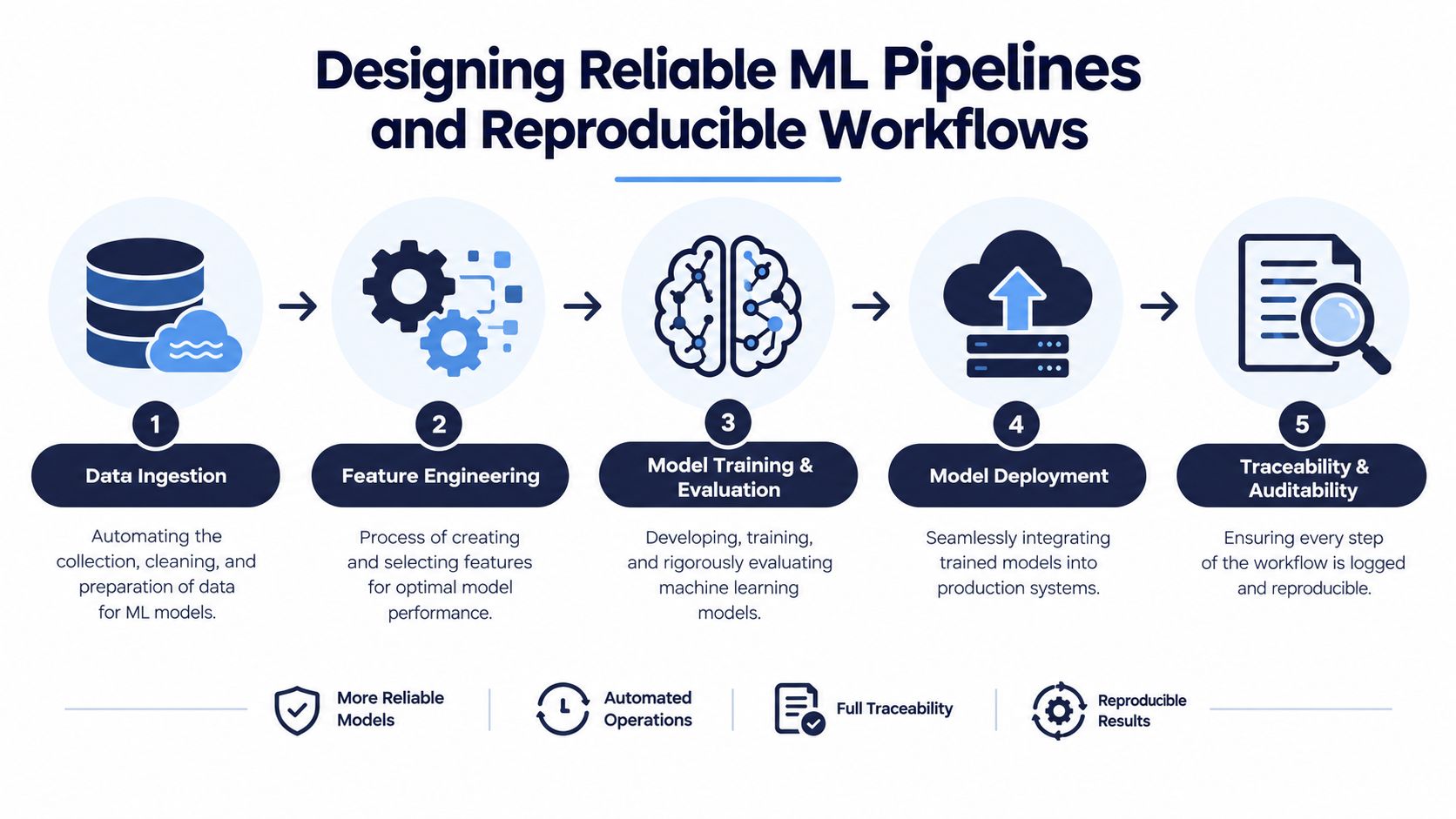
Reliable ML pipelines are predictable on purpose. They move data, training, and release steps through the same path every time, so teams can spot where a failure starts instead of guessing after the fact. That matters because ad hoc scripts may work until a dependency changes, a dataset shifts, or the runtime environment drifts.
Start with the path, not the tool
Consultants usually begin by mapping the full sequence of operations. They define what data gets ingested, how it is cleaned, where features are created, how training is triggered, and how the model reaches production. Once that flow is visible, the team can decide which parts belong in containerized jobs, which should be orchestrated through CI/CD, and which should be tracked in a registry.
Make every artifact traceable
Reproducibility depends on keeping the chain of evidence intact. Datasets, model binaries, configuration files, and evaluation results should all be versioned together. Infrastructure-as-code helps too, because it lets the runtime environment be recreated instead of reconstructed from memory.
This approach also fits real delivery work, including this platform delivery project, where traceability and operational clarity shape how the system is built and handed over.
Keep the workflow inspectable
A pipeline that cannot be audited becomes a liability in regulated or high-availability settings. Consultants often recommend logging each run, storing evaluation outputs, and keeping promotion criteria explicit. If a model is promoted, the team should know why. If it is rejected, the team should know what broke.
The point is not just automation. It is making each step visible enough that another engineer can reproduce the run, review the outputs, and continue the work without rebuilding the stack from scratch.
The best workflows make handoffs predictable. If a data scientist leaves, another engineer should still be able to follow the same path, inspect the artifacts, and move the system forward with confidence.
Implementing production-grade monitoring and model operations
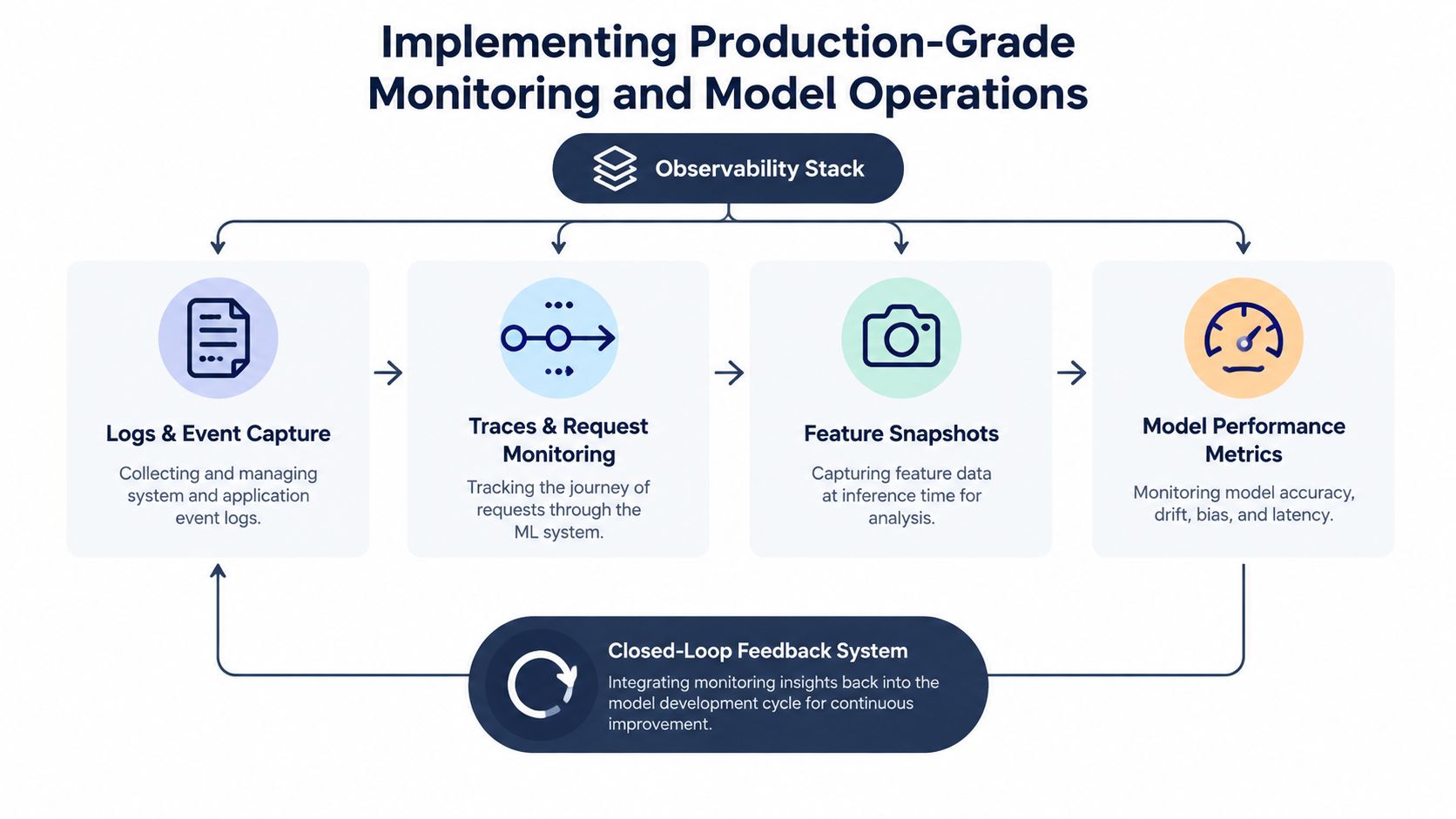
Monitoring is where many ML projects either become reliable services or decay. A dashboard alone isn't enough, because a dashboard only shows a moment in time. Real monitoring compares production behavior against a baseline and tells engineers when the system has drifted, regressed, or started failing under traffic.
Build the observability stack in layers
Consultants usually start with logs, traces, and request monitoring. Then they add feature snapshots, prediction records, and model performance metrics so the team can line up what the model saw with what it produced. That layered view matters because it helps distinguish data issues from service issues and model behavior issues.
Use feedback loops, not static views
A production monitoring system should compare live data against training or recent production baselines, then trigger alerts when thresholds are crossed (KodeKloud). That design is more useful than a one-time report because it lets engineering teams respond while the issue is still contained.
Operational truth: silent failure is the hardest failure in ML, because the endpoint keeps answering even when the answers are getting worse.
Tie model health to service health
Model metrics alone don't tell the whole story. Latency, error rates, and throughput matter because users experience the whole service, not just the prediction engine. In regulated or critical systems, consultants also define fallback behavior, staged cutovers, and escalation paths so the service remains usable while the model is investigated.
For teams looking at adjacent architecture choices, this multi-LLM stack reference is a useful reminder that production AI usually needs clear routing, observability, and fallback thinking, not just model access.
The goal is simple. When something shifts, the team should know whether to retrain, roll back, or investigate infrastructure before a customer ever notices.
Driving ROI with MLOps consulting
The ROI story is strongest when you look at incident handling, not just launch speed. Effective monitoring that captures inputs, predictions, actuals, and drift can reduce the time from anomaly detection to root-cause analysis by over 50% (Deepak Karkala). That matters because every minute spent searching for the cause of a bad prediction adds cost, risk, and uncertainty.
Where the business value shows up
A better observability stack shortens diagnosis time, which shortens downtime and limits the blast radius of bad releases. It also helps teams decide when to retrain, when to roll back, and when the issue is upstream data quality rather than a model defect. That's the kind of clarity executives pay for, because it reduces operational waste and customer-impacting errors.
The bigger ROI comes from reducing hand-built work. When deployment, monitoring, and rollback are standardized, engineering teams spend less time reinventing release mechanics and more time improving the product. That's also how organizations keep unit economics under control as usage grows.
Why the consulting fee can pay back quickly
A consultancy isn't selling a dashboard, it's selling a safer operating model. That model can prevent expensive false starts, reduce the number of people pulled into every incident, and make model ownership clearer across teams. When AI systems become business-critical, those savings matter more than the novelty of the model itself.
For a real-world example of this kind of applied engineering focus, see this AI and software leadership work, which reflects the same emphasis on production readiness and operational discipline.
If a model is important enough to influence revenue or risk, it's important enough to monitor like production software.
The shortest path to ROI is usually not a fancier model. It's a system that fails less often, fails more visibly, and recovers faster.