
Post-Odido Hack: Building Secure Customer-Data Pipelines
The announcement from the Dutch Data Protection Authority on 16 April 2026 marks a turning point in how Dutch and European companies need to approach customer-data infrastructure. Following breaches at Odido (6 million accounts), Clinical Diagnostics (855,000 records), Booking.com, and Basic-Fit, the AP is moving from reactive investigations to preventive audits of ICT providers.
That shift has immediate implications for every organisation processing customer data at scale. The question is no longer whether your data pipelines will be scrutinised, but when — and whether your architecture can withstand that scrutiny.

What the AP audits mean for your architecture
The AP’s preventive checks focus on three specific areas: server-security testing, update verification, and compliance with data minimisation. These are not abstract regulatory boxes. They connect directly to architectural decisions many organisations have deferred for years.
Server-security testing means your infrastructure must demonstrate defence in depth. Protection at a single layer is no longer enough — the layered controls have to be documented as well as present. Update verification requires documented patch management with an evidence trail. But it is the third requirement — ensuring organisations “do not store more data than necessary” — that will force the most significant architectural changes.
Most customer-data pipelines were built in an era when storage was cheap and data was considered valuable by default. The prevailing logic was simple: collect everything and work out what matters later. That approach is now a liability. Every unnecessary data field represents regulatory exposure.
The AP explicitly noted that investigations are also needed into organisations that have never reported a data breach. This suggests that organisations with an unusually clean record may receive more scrutiny. If you are not able to detect breaches properly, you may expose yourself twice: once to the breach itself and again to the appearance of concealment.
The ICT-provider problem
Here is the uncomfortable truth underlined by the AP announcement: you remain responsible for data even when a third party processes it. The Odido breach did not originate in its internal systems — the attack vector ran through its supplier ecosystem. Odido still carries the regulatory burden and reputational damage.
This creates a real dilemma for Dutch companies. Building everything internally is unaffordable and often produces weaker security than specialised providers can offer. But outsourcing data processing means accepting that your security posture is only as strong as your weakest supplier.
The way forward requires fundamentally rethinking supplier relationships. Instead of treating ICT providers as black boxes that merely “process data”, organisations need continuous assurance mechanisms.
In practice, that means:
Not annual certifications that sit in folders, but quarterly penetration-test results, real-time security-status dashboards, and immediate breach-notification requirements backed by meaningful sanctions.
Architectural data separation. Your customer data should exist in isolated tenants within supplier systems, not be mixed with other customers’ data in shared databases. The Clinical Diagnostics breach showed how shared infrastructure multiplies the impact of a breach.
If your provider is compromised, you should be technically able to migrate your data within days, not months. That requires parallel implementation options and documented failover procedures.
Designing for data minimisation
The AP’s focus on organisations storing “more data than necessary” requires a shift from data-maximising to data-minimising architecture. This is not only about deleting old records. It is also about redesigning pipelines so unnecessary data is never collected.
Consider a typical customer-onboarding flow. Most systems capture full names, addresses, dates of birth, phone numbers, and identity documents simply because the forms ask for them. But do you actually need all of that for your core service?
A data-minimising pipeline reverses the collection logic. Start by defining the minimum data required for each specific processing purpose. Then implement technical controls that prevent collection beyond those requirements.
This approach has direct security benefits. Breach impact depends directly on the volume and sensitivity of the data exposed. If you never collect dates of birth you do not need, they cannot be stolen. If you hash identifiers immediately upon receipt, the raw values never exist in an exploitable form.
The trade-off is real: data minimisation limits future analytics. You cannot mine data you never collected. Organisations need to make deliberate choices about which analytical possibilities they are willing to trade for reduced breach exposure.
For most Dutch companies, the balance favours minimisation. Regulatory and reputational breach costs now outweigh the speculative value of hoarded data. Basic-Fit learned this painfully: the data that enabled its breach likely offered marginal business value while creating existential risk.
Building audit-ready infrastructure
The AP’s move towards preventive audits means your infrastructure must be continuously audit-ready, rather than scrambling to produce evidence when regulators arrive. This requires investment in three capabilities.
Continuous security monitoring. Manual security reviews produce point-in-time snapshots that can be out of date within hours. Implement continuous monitoring that flags configuration drift, unauthorised-access patterns, and patch-compliance gaps in real time.
Immutable audit trails. If the Public Prosecution Service asks how a breach happened, you need forensic logs attackers could not alter. That means write-once log architectures with cryptographic verification, stored in separate systems with independent access controls.
Decision records. Regulators increasingly want to understand not only what you did, but why. Keep decision logs that explain architectural choices, risk-acceptance decisions, and trade-offs. If you choose to retain particular data despite minimisation principles, document the business justification and mitigating controls.
The organisations that will struggle most are those with sprawling legacy systems whose data flows are poorly understood. You cannot secure what you cannot map. Invest in comprehensive data-flow documentation before implementing new controls. Where does customer data enter your systems? Where does it go? Where does it rest? Who can access it at each stage?
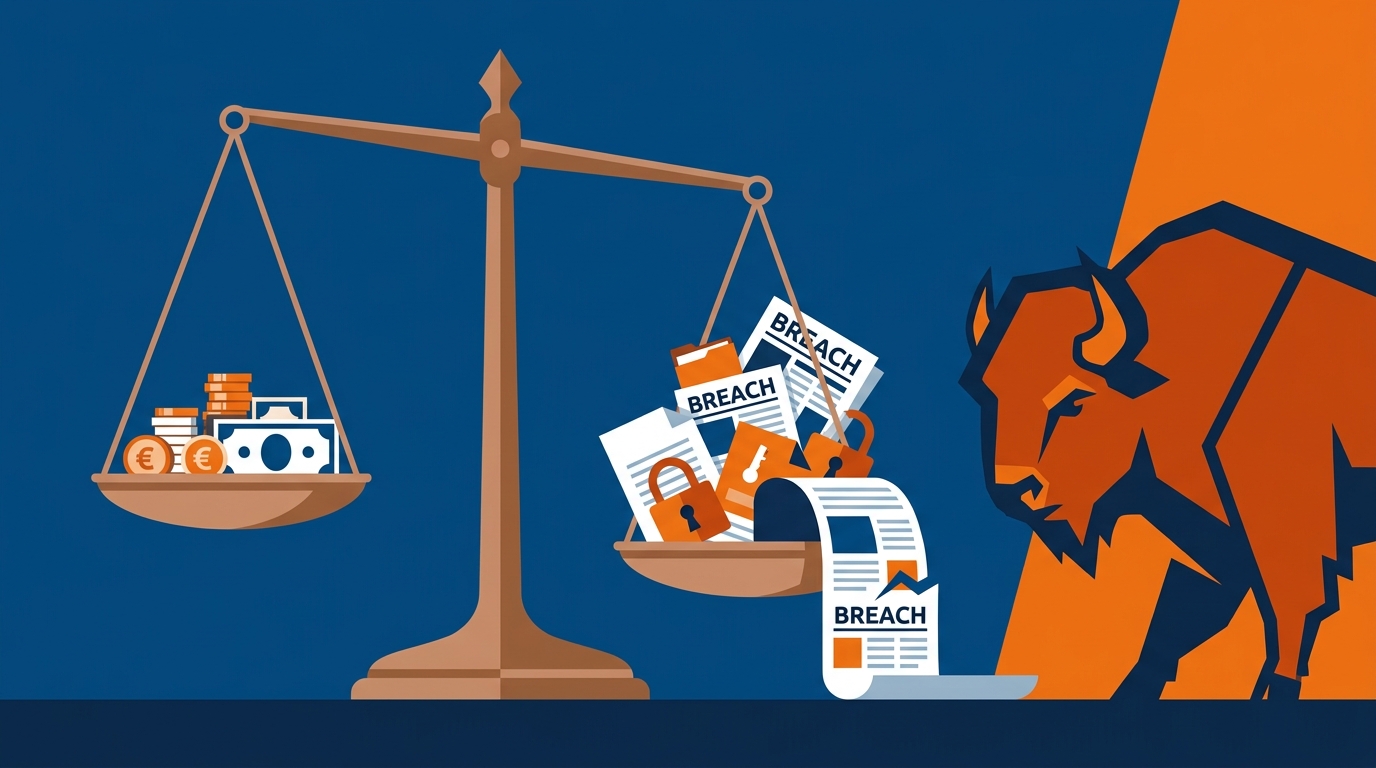
The cost-risk calculation has changed
For years, security investment competed with feature development for limited budgets. Security was treated like insurance — necessary but unexciting, always at risk of losing priority when growth targets came into view.
The Odido breach changed that calculation. Beyond the immediate cost of breach response, Odido faces continuing reputational damage in a competitive telecom market. Its customers now have tangible evidence that switching provider can reduce their personal risk exposure.
The AP’s budget constraints — explicitly acknowledged in its announcement — mean enforcement will be selective. But selectivity creates its own perverse dynamic. Organisations that suffer breaches will face intense investigation. Organisations with a poor security posture will eventually join that group. The only sustainable position is to invest in security, not merely in compliance.
Moving forward
The post-Odido regulatory environment calls for proactive architectural change, not reactive patching. Organisations should prioritise three immediate actions.
First, perform a ruthless data inventory. Identify every customer-data field you collect and challenge its necessity. Remove data that does not pass that test.
Second, stress-test your suppliers’ security. Ask for evidence of controls, not only certificates. Use your contractual audit rights before regulators exercise theirs.
Third, build audit-ready infrastructure in which compliance is treated as continuous rather than periodic.
The AP’s shift towards preventive audits represents a maturation of Dutch data-protection enforcement. Organisations that see this as an opportunity to strengthen their infrastructure — rather than as a burden to minimise — will build competitive advantages that compound over time.
If your organisation needs help designing customer-data pipelines that balance operational needs with the new regulatory reality, our team has supported Dutch companies through exactly these architectural transformations.