
Agentic AI Workflows: A Practical Guide for 2026
Agentic AI workflows are already in production, but the uncomfortable part is that most of them still fail for operational reasons, not model reasons. In 2026, a major industry report found that 57% of organizations were already deploying AI agents for multi-stage workflows, while only 16% had reached cross-functional or end-to-end processes across teams or business functions, which is a clean signal that adoption is moving faster than deep integration The 2026 State of AI Agents Report. That gap is where pilot enthusiasm runs into reliability, governance, and legacy systems.
A useful way to think about this category is simple, an agentic AI workflow is not a chatbot with a longer answer. It's a system that can plan, call tools, track state, and continue across steps until it completes a bounded task, or hands off when it can't. That difference matters because once an AI is allowed to act, you inherit the same engineering questions you'd ask about any production system, identity, permissions, retries, observability, rollback, and accountability.
Table of Contents
- What Agentic AI Workflows Actually Mean in Practice
- The Building Blocks of an Agentic Workflow
- Common Workflow Patterns and Their Trade-offs
- Orchestration, Evaluation, and Tool Use
- Safety, Governance, and Bounded Authority
- Why Most Agentic Workflows Stall Before Production
- Integrating Agentic Workflows into Existing Systems
- Questions Engineering Leaders Ask Before Shipping
What Agentic AI Workflows Actually Mean in Practice
A fintech team ships an agent to triage loan-application exceptions. It looks solid in staging, the prompts are clean, the tool calls are structured, and the early reviewers like the speed. Then, on day six, the agent approves two files that should have been blocked under compliance rules. That's the point where the conversation stops being about “can the model reason?” and starts being about workflow boundaries, tool access, and what happens when the loop takes the wrong turn.
At practice level, agentic AI workflows are systems where an LLM-driven agent makes decisions inside a defined boundary, invokes tools, observes the result, and chooses the next step. They're different from chatbots because chatbots answer, while agents act. They're also different from traditional automation because fixed automation follows predetermined branches, while an agent can adapt its path when the input is messy, incomplete, or ambiguous.
The boundary is the real product
The useful question isn't whether an agent can generate a clever response. It's whether the system can complete a task with bounded autonomy and recover when something goes wrong. That's why production systems need explicit limits on what the agent can touch, how far it can go, and when it must stop and ask a human.
Practical rule: if a workflow can't be described as a boundary plus a sequence of permitted actions, it's not ready for autonomy.
The rest of the stack follows from that. If the agent can't keep state across steps, it can't manage a multi-stage task. If it can't use tools safely, it can't do anything real. If it can't hand off cleanly, it becomes a liability instead of an operator. Agentic AI workflows are powerful precisely because they sit between static automation and open-ended autonomy, but that middle ground only works when the engineering team treats the boundary as a first-class design object.
The Building Blocks of an Agentic Workflow
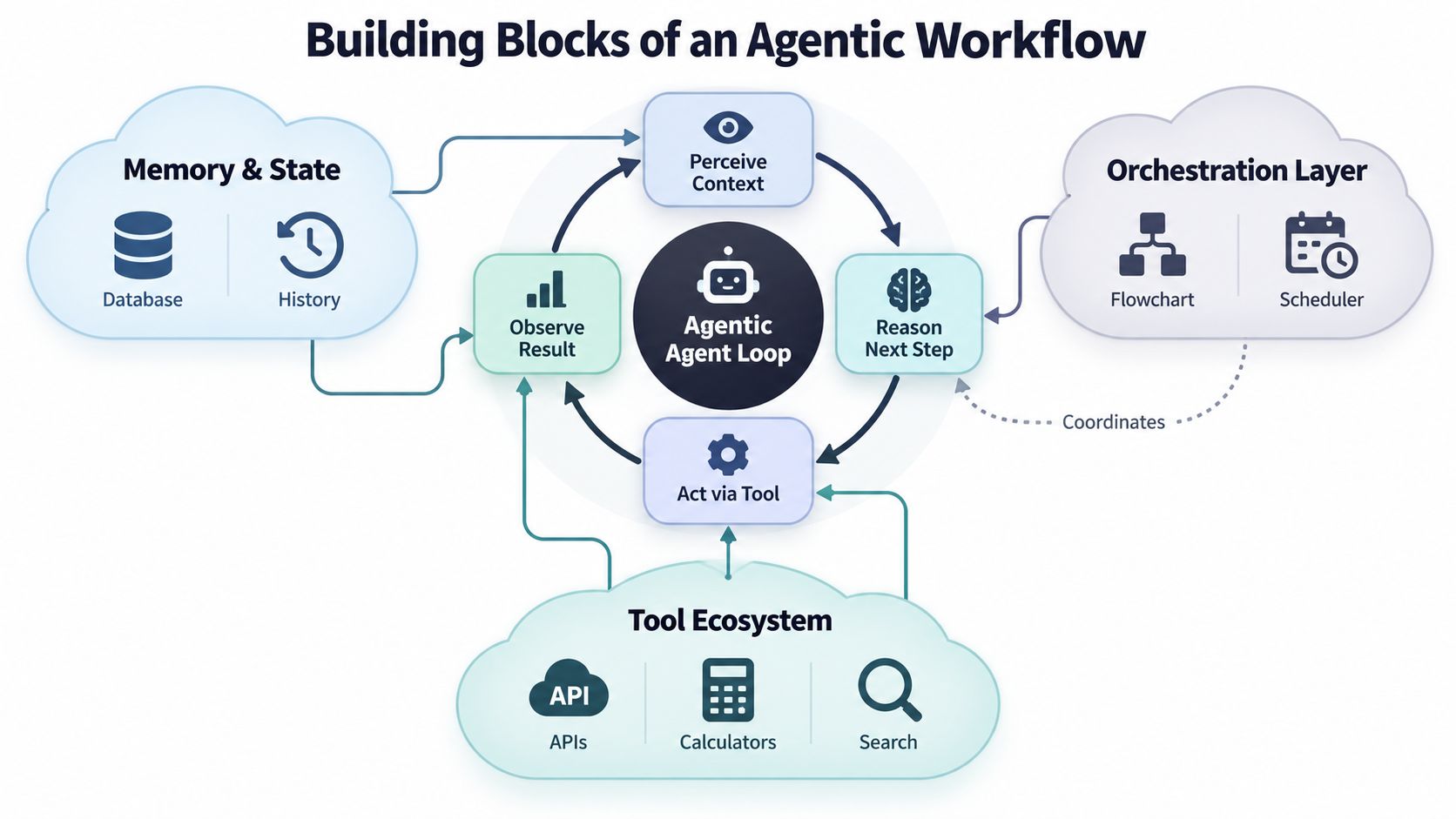
Think of one agent as a junior analyst with a laptop, a notepad, a filing cabinet, and a supervisor. The laptop is the model loop, the notepad is short-term working memory, the filing cabinet is persistent state, and the supervisor is orchestration. If any one of those is missing, the workflow either forgets what it's doing, acts blindly, or never completes a task cleanly.
The agent loop does the immediate work
The core loop is straightforward. The agent perceives context, reasons about the next step, acts via a tool, and observes the result. That cycle repeats until the task is done or the runtime stops it. In a real workflow, the model is rarely doing pure reasoning in the abstract, it's deciding whether to query a database, pull a record, ask for clarification, or escalate.
Tools, memory, and orchestration do the heavy lifting
The tool layer is everything the agent can touch, APIs, databases, code interpreters, retrieval systems, or internal services. The memory layer keeps short-lived scratchpad state, task history, and any persistent facts that need to survive across steps. The orchestration layer coordinates the loop, which means scheduling, step limits, retries, and handoffs when the workflow can't proceed.
The reason this matters is that the model itself is never the whole system. A workflow becomes reliable only when the runtime makes the action sequence legible and recoverable. That's why the supervisor analogy holds up. The supervisor doesn't do the work, but it defines the route, tracks progress, and stops the analyst from wandering outside scope.
A workflow is only as good as the state it preserves and the actions it can safely repeat.
Put together, these blocks form a complete execution pattern. The model decides, the tool executes, memory preserves continuity, and orchestration enforces constraints. When that stack is clean, the agent can handle multi-step work without turning every request into a brittle one-off script.
Common Workflow Patterns and Their Trade-offs
There isn't one correct agent architecture. The best choice depends on whether the work is linear, branching, high-risk, or noisy. Teams get into trouble when they try to force every problem into the same pattern, especially when the cost of a wrong step is high.
| Pattern | Structure | Common failure modes | Best fit |
|---|---|---|---|
| Single-agent with tool use | One agent decides and calls tools directly | Overreach, hidden loops, weak recovery when a tool fails | Narrow tasks with clear guardrails |
| Supervisor with sub-agents | One controller delegates to specialized agents | Coordination overhead, conflicting outputs, slow escalation | Tasks with distinct specialties |
| Sequential pipeline of agents | Output from one agent feeds the next | Error propagation, brittle handoffs, hard debugging | Well-defined multi-step processes |
| Parallel fan-out with aggregation | Several agents work in parallel, results are merged | Inconsistent outputs, merge ambiguity, cost inflation | Research, comparison, and review tasks |
| Iterative critique and revise | One agent drafts, another critiques, then revises | Looping without progress, subjective churn | Content and analysis tasks with review value |
Structure should follow task shape
A single-agent setup is usually the cleanest starting point when the workflow is short and the action set is small. It becomes brittle when the agent has too many tools or too much freedom. A supervisor pattern helps when different steps need different expertise, but the handoffs can become harder to debug than the original task if ownership isn't clean.
Sequential pipelines work well when each stage can be validated independently, but one bad stage can poison the rest of the chain. Parallel fan-out is useful when you need breadth, not certainty, but you pay for that breadth in merge logic and latency. Iterative critique loops can improve quality, yet they can also keep the system busy without producing a stronger result.
The practical heuristic is blunt. If the task has one dominant path, keep the agent simple. If the task has multiple valid subpaths, use a supervisor or a pipeline. If the workflow depends on comparison or synthesis, fan out. If the goal is quality control, add critique, but cap the loop so it doesn't keep rewriting forever.
Orchestration, Evaluation, and Tool Use
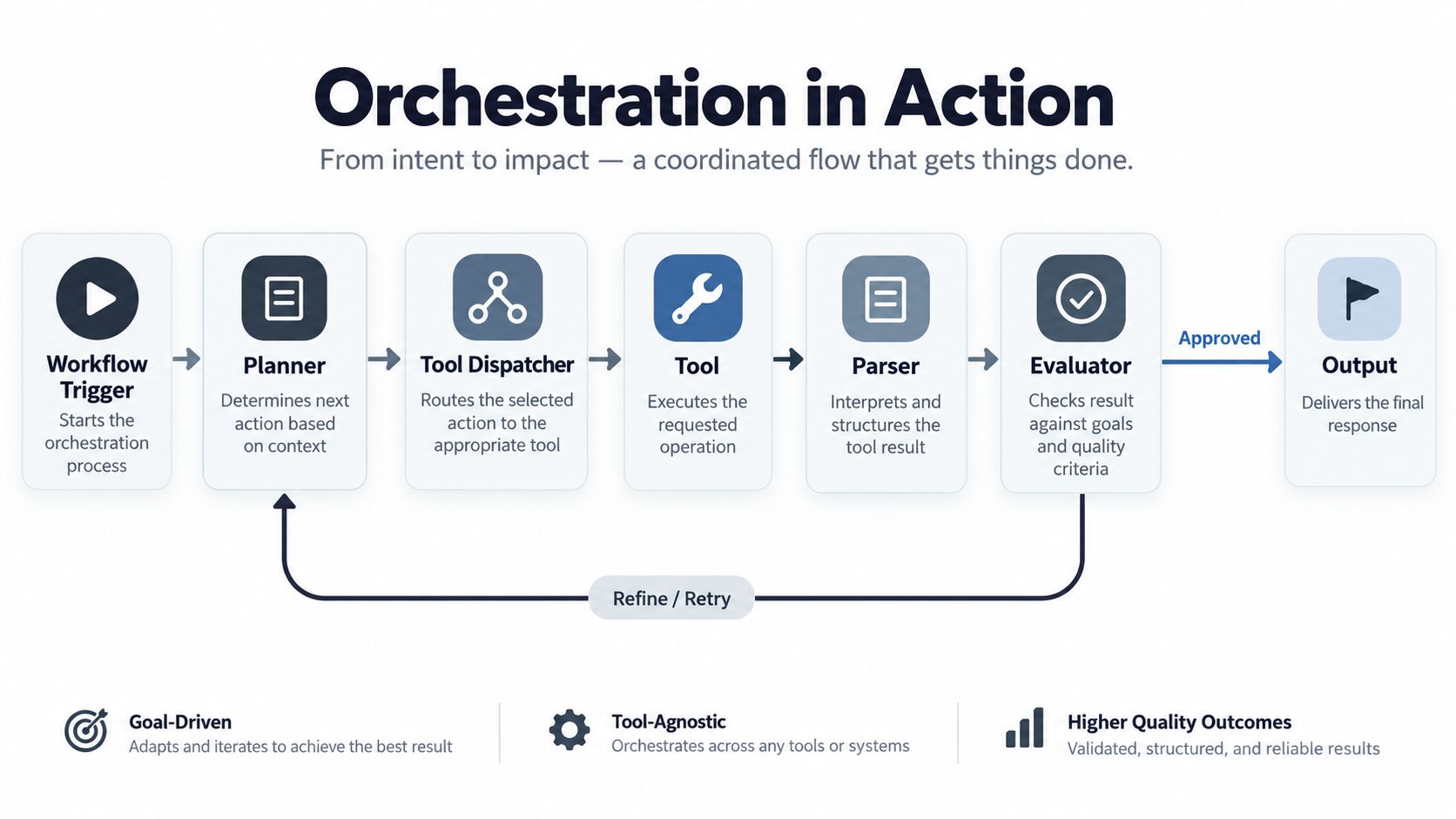
Once an agentic workflow is live, orchestration becomes the control plane. A planner chooses the next action, a dispatcher sends the tool call, a parser turns the result into structured state, and an evaluator decides whether to continue, retry, or hand off. That control loop can be partly deterministic, partly model-driven, and the strongest production systems usually combine both.
Deterministic control and model choice should coexist
Purely model-driven orchestration is tempting, but it makes failures harder to reproduce. Deterministic structures like DAGs, state machines, and scripted branches give you predictable checkpoints. Model-driven choice is still useful inside those bounds, especially when the workflow must decide between tools, retry paths, or escalation paths based on context.
Tool design matters just as much. Every wrapped API should have a schema, an authentication boundary, timeout budgets, and idempotent behavior where retries are possible. If a tool can double-write or trigger a side effect twice, the agent runtime needs protection before the model gets access to it.
Evaluation has to score trajectories, not just answers
Pilots usually die here. A workflow can look fine if you only inspect the final answer, while the actual action trail is broken. The WORFBENCH benchmark shows why graph-aware evaluation is more useful here, it reports 18,679 training samples, 2,146 test samples, and 723 held-out tasks, and it scores whether an LLM can generate executable multi-step workflows with correct branching and dependency structure WORFBENCH.
That matters because workflow failures are often structural, missing steps, wrong ordering, or broken dependencies. For production work, procedure-level metrics are more useful than vibe checks. Measure tool-call accuracy, step efficiency, and whether the trajectory matched the intended graph. Then add outcome metrics grounded in business signal, because a technically correct trace still fails if it doesn't solve the actual user problem.
You can't ship that discipline without replay. Offline harnesses catch regressions before users do, and shadow runs let you compare candidate changes against live traffic without putting them in charge. If the orchestration layer changes and no replay harness notices, the evaluation layer is too shallow.
Safety, Governance, and Bounded Authority
Safety isn't a policy memo. It's an architecture decision about how much authority an agent gets, and under what constraints. The cleanest principle is bounded authority, every action must be scoped to an identity, a permitted tool set, a budget, and a blast radius.
A 2026 security analysis reported that only 21% of organizations keep a fully up-to-date inventory of agents, tools, and connections, while 79% have no formal governance policy for AI agents or MCP connections and 60% have not performed an AI or agentic risk assessment in the last 12 months Agentic AI security readiness is lagging enterprise adoption. That's not a tooling gap. It's a control gap.
Controls need to be enforced in the runtime
Scoped tokens with short TTLs keep access from lingering longer than the task. Allowlisted tool APIs reduce the surface area of what the agent can touch. Human approval checkpoints belong on irreversible actions, not on every low-risk step, because excessive approval destroys the workflow. Sandboxed execution helps when code or data transformations need isolation, and structured validators should reject malformed tool calls before they reach downstream systems.
Governance needs more than access control. Decision logs, audit trails, and policy-as-code give teams a way to answer who did what, when, and under which permissions. Red-team evals should probe for prompt injection, data exfiltration, and runaway loops, because those are the failure modes that matter when an agent is allowed to act continuously.
If an action can't be explained, logged, and rolled back, it shouldn't be autonomous.
Observability closes the loop. Trace every step, sample trajectories for review, and define kill switches that can halt a misbehaving workflow in seconds. That gives engineering, security, and operations one shared view of the system, which is the only way bounded authority stays real after launch.
Why Most Agentic Workflows Stall Before Production
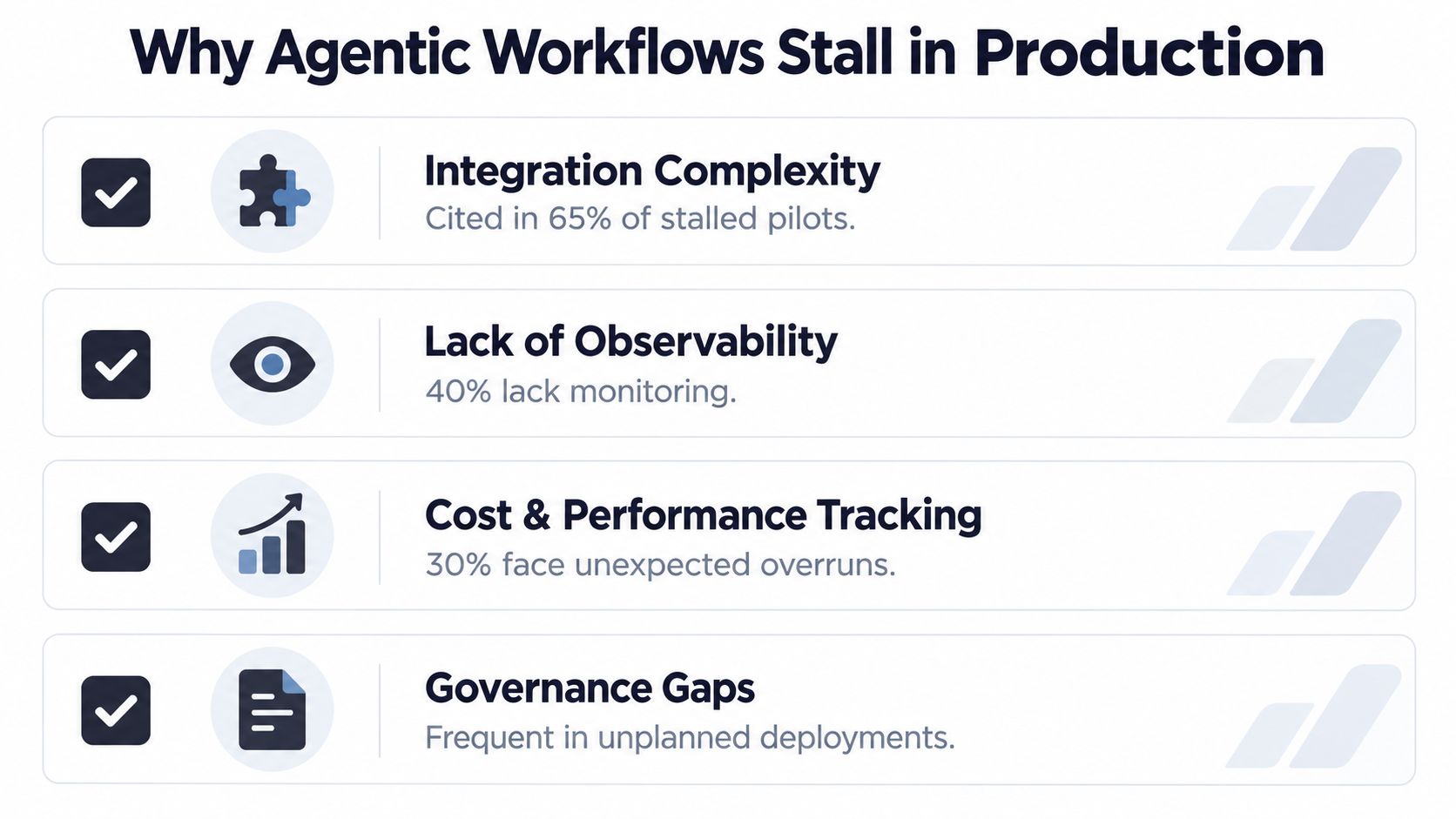
The biggest mistake is treating model quality as the main blocker. The transition usually fails at the operational layer. A 2026 systematic review found that fewer than 24% of pilot programmes successfully reached operational status, and it linked those failures to long-horizon reliability, multi-agent oversight, benchmark quality, and safe integration with existing systems Systematic review on agentic AI deployments. A pilot can look solid in a narrow demo and still break once it has to run inside a real business.
The pattern behind those stalls is familiar. Legacy integrations are messy, ownership is unclear, observability is thin, and no one has defined what “good” looks like when the agent makes a plausible but wrong decision. The rollout slows because the operating model is vague, not because the model is unusable.
A production readiness checklist that actually matters
- Defined use case: The workflow needs a measurable outcome, not just a convincing demo.
- Instrumented tool layer: Every call needs traceability, because debugging blind agents is slow and expensive.
- Trajectory evaluation: Review the full action path, not just the final text.
- Scoped permissions: The agent should only touch what it needs.
- Audit and rollback: Every important action needs a log and a reversal path.
- Named owner: Someone has to own quality, cost, and escalation.
A practical detail from engineering teams I've worked with, the rollout usually breaks at the seams between the AI layer and the existing system, not in the prompt itself. That is why thinking in smaller commits applies here. Ship the workflow in narrow slices, validate each boundary, and harden the integration before you expand the agent's scope.
Integrating Agentic Workflows into Existing Systems
The safest entry points are the boring ones, and that is a strength. Wrap an existing API as a tool, keep the workflow inside a microservice boundary, or run the agent loop beside a human queue that already has approval steps. Those patterns keep the systems you trust in place while giving the agent a narrow job.
Identity propagation has to be explicit. If the workflow retries, the same state should survive, the same action should not duplicate, and the trace should show which tenant or request triggered the step. Cost attribution matters too, because shared infrastructure can hide runaway spend until the wrong team pays for it.
Integration contracts should exist on day one
The rollout checklist is simple to say and hard to fake:
- Idempotent tool calls so retries do not create duplicate side effects.
- Schema-validated input and output so malformed actions get blocked early.
- Versioned prompts and tool definitions so you can compare behavior across releases.
- Rollback paths for every action that can change state.
- Return-to-human rules that define exactly when control leaves the agent.
A reference implementation can help, but only if it fits the stack you already run. A practical example is KLM airport slot management automation, which shows how workflow automation has to respect existing system boundaries, approval paths, and operational constraints.
One production-minded example is Dario Mory, which focuses on taking prototypes to production with evaluation pipelines, guardrails, and unit cost control. That kind of delivery work only matters when it fits the system already in place.
The order matters. Put observability in first, then bounded authority, then evaluation. Each layer makes the next one more useful. If you reverse that order, you often end up with a system that looks advanced but cannot be trusted.
Questions Engineering Leaders Ask Before Shipping
The first question is ownership. If the agent makes the action, who owns the outcome, and how is it logged? The answer has to be a named human or team, with a trace that captures the decision, the tool call, and the resulting state change. Without that, you do not have accountability, you have automation with no operator.
The second question is legacy integration. A stable API contract is usually cheaper to defend than direct access to internal services, especially when the agent is still learning the shape of the workflow. Direct integration can work, but only when the service boundary is already mature, permissions are tight, and the rollback path is real.
The third question is budget. Every workflow should have a per-action cost ceiling, a token budget, and a circuit breaker for abnormal loops. If a task cannot stay inside that envelope, it is not ready to run unattended in production.
The hardest question is when not to use agents at all. If a deterministic rules engine, a well-tuned retrieval workflow, or a simple scripted process solves the problem with lower variance, ship that instead. Agents belong where the input is ambiguous, the task is multi-step, and tool use changes the plan.
| Workload Characteristic | Recommended Approach | Reason |
|---|---|---|
| Clear rules and stable inputs | Rules engine or deterministic workflow | Lower variance and easier debugging |
| Mostly retrieval and summarization | RAG pipeline | Simpler control and stronger predictability |
| Ambiguous input with tool use | Agentic workflow | Needs planning plus action |
| High-risk irreversible action | Human-approved workflow | Control matters more than autonomy |
| Repeated multi-step operational work | Agent with bounded authority | Automation pays off when the loop is constrained |
Agentic systems are useful when they help a team do real work that used to require manual coordination. They are a poor fit when the organization wants a demo, but not the discipline that production demands.